
Good Tools Aren't Enough
Prudence in the driver's seat

Before I get into this topic, I want to pull on a thread from my last post about motherhood and honor my own mother who celebrated her birthday yesterday. I learned first from watching her what it looks like to give and see things waken to life — let’s just say I have a privileged position to say so, as she gave me life and has guided me through so much of it. : ) Happy birthday mom. I love you!
One of my favorite ways to think about the tools that we use comes from Ivan Illich who gives us the gift of the word “conviviality” to describe the Really Good Ones. Although he wrote a whole book on the topic which you can read for free HERE on the Internet Archive (speaking of convivial tools), he seems to me to be almost always revisiting this question regardless of his subject material, whether it’s systems of thought, education, medical care, theology, economics, or whatever. How do we determine which tools we should use? This is a core question not only for him, but for all of us as we are called upon to continually what makes for a Good Tool in the rapidly-evolving landscape of technologies. (Please look up L. M. Sacasas at The Convivial Society for his consistently excellent essays on this topic. They are so good.) Is it better to buy an EV? Why? Do I need all these apps on my phone? What settings on my phone create the most sanity? What is email actually FOR now (with my 21,023 unread messages)? Am I just a silly romantic for buying that typewriter at the thrift shop? Should my kids be allowed to use a tablet? How much? Do I need a new vacuum? Air filtration system? Is it more ethical to buy clothes from Costco or Target? Is Amazon taking over the world? Is AI destroying us all? Will my children have a job if they go to trade school? Is it more virtuous to read a recipe off a card or the Internet? Is Siri a spy? Can I get rid of some kitchen appliances? I can’t quite imagine life before my immersion blender but maybe the air fryer can go.
I could go on but you get the point. I have been asking myself for a while now which tools are more or less convivial by holding them up next to Illich’s definition, which is to say those tools which “give each person who uses them the greatest opportunity to enrich the environment with the fruits of his or her vision.” He sees convivial tools in opposite designation to “industrial productivity” which aims always to “scale up,” a darling of a catchphrase in the business world these days. Convivial tools may offer efficiency (what would a tool be, if it didn’t offer some measure of efficiency?) but if that efficiency becomes more important than, say, a habitable environment, or reasonable work conditions, or the free and democratic exchange of ideas, or access to historical wisdom and tradition — well, me must reconsider the tool. This is Illich’s Very Good Question.
Related to this Very Good Question, I have begun to wonder lately whether it is enough to select the “right” tools. When I lay down a tool that is less than convivial, will that act automatically transform me into a better person? If I put my phone in a Yondr pouch during a retreat, will that practice of laying it aside actually produce a lasting change for the better in myself. What if I ditch a smartphone completely? My instinct says no, but I want to know why. If it’s not enough to give up a tool, what else do we need?
Prudence, Charioteer of the Virtues
Enter prudence. This historically rich word has the unfortunate burden of being reduced to something like “cautiousness,” keeping one’s opinion to oneself, or even worse, being a “prude.” I propose bringing back this word in all its charioteering glory, starting with a basic definition and then looking at its three classical parts. It is a most excellent combination of freedom and discipline which is beginning to help me understand my relationship to Tool, Self, and World — as we will see.
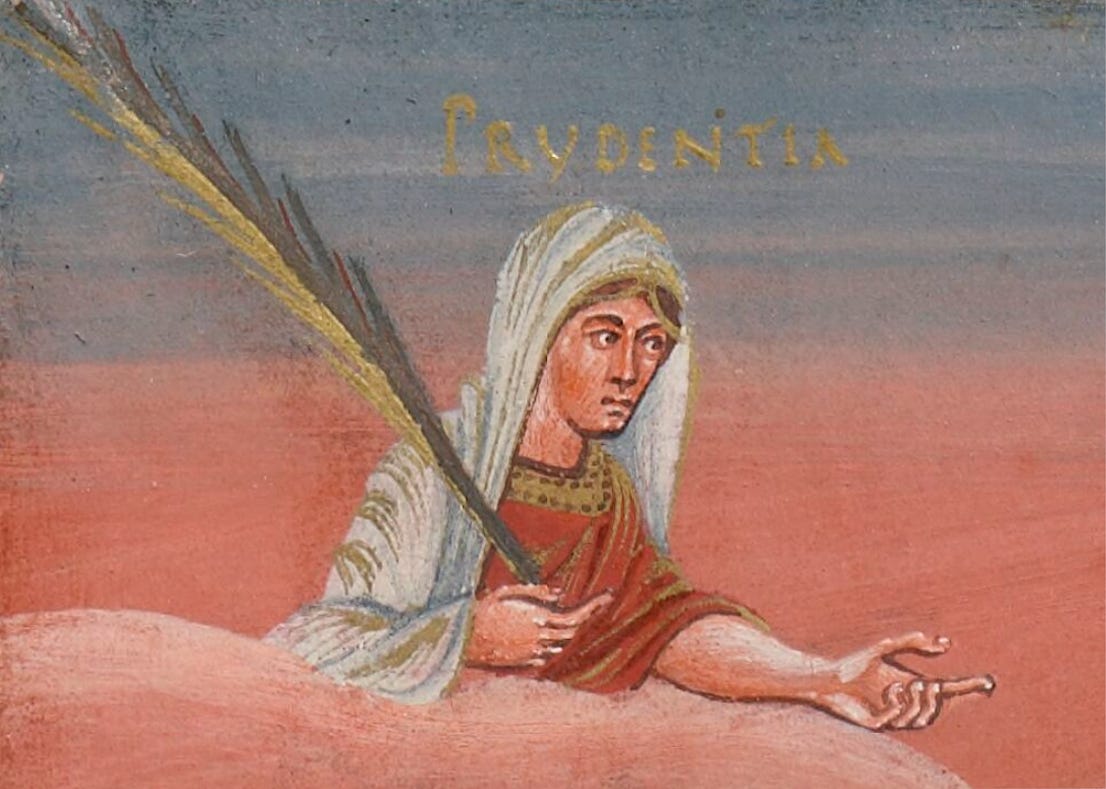
Prudence is one of the four classical virtues, which mainly means that we’ve been talking about them in western thought culture since the ancient Greeks and on through the lovingly organizing culture of medieval Europe. From Aristotle to Aquinas. It’s less common to bring it up today, except fossilized in very narrow meanings and phrases (and bank names!) but that’s a real shame because we’ve been mostly selling Prudence cheaply in the yard sale of ideas. We cleaned out the garage a couple times in the past couple hundred years (from enlightenment to postwar philosophical skepticism) and unfortunately some good things got thrown out with the bad. These good words, which are themselves pointing at Tools have been sold for a quick dollar. Let’s try to restore them.
Prudence is basically seeing the truth as best we can and acting on it. Aristotle called it practical wisdom and talks about it beautifully. However my favorite thing that happened to “prudentia” is when Thomas Aquinas divided it into three parts: memoria, docilitas, and solertia. And unless you grew up in a classical-heavy Catholic subculture, these are probably new concepts to you. I certainly didn’t meet them until I was in my forties. Better late than never!
Memoria (memory) is the power of remembering reality as truly as one can. We all know that our own memories play tricks on us. We swear up and down that so-and-so wasn’t at that party, until someone shows us a photo. Ran the red light? I was sure it was yellow, officer. We must humbly own up to the fact that we are limited in our human capacity to remember things correctly, despite all the possible ways this could go sideways. To tell the truth, the whole truth, and nothing but the truth, so help me God. The memoria part of prudence urges us to keep this in mind and make sure to do the best we can to remember things accurately, and this is the kicker — especially there’s a matter of personal advantage at stake. It’s a good combination of realistic humility and being willing to still try. So help us God.
Docilitas (docility) is the power of submitting to the guidance of others. You can see how this overlaps with memoria and guards us from being a blowhard know-it-all. If I am willing to accept the help of others’ perspectives, it offsets the heady and extraordinary agency which prudence otherwise is proposing to grant to us. With all this freedom, we have the guardrails of our neighbors, without being beholden to them.
Solertia is untranslatable into English which tickles me to no end but means something like “nimble decisiveness.” I love this part the most and hope someday to really develop this power. The person who has grown this part of their soul can quickly size up and act according to their good goals. You all know the type in your friend group. Everyone’s waffling about where to go and what to do, and one person inspiringly takes to lead to everyone’s relief, proposes just-the-right restaurant and gets everyone headed in that direction without wasting any more time.
With these three parts (and my mystical bent wants to say there’s probably 101 more parts of prudence, but this I say good start), we have a picture of a human who is free, joyful, humble, and considerate among other things. This is why she steers the other virtues as “charioteer.”
Google Maps in the Driver’s Seat
Speaking of driving, I’d like to give a live example from my own life. Sometime last year I decided to do an experiment on myself. I’d had the conviction for a couple of years that using Google Maps on my phone to get everywhere was not a convivial way to live and that it was stunting my own perception of the world. Now, whether you still say things like “mapquest it” by accident or you’re asking the latest version of Siri in a sexy accent to get you somewhere, this is a nearly ubiquitous practice. Don’t take this critique as a personal affront. This practice has become this way partially because it piggybacks on yet another modern unconvivial practice, which is the automobile + highspeed highways, which I am unlikely to give up any time soon, so just know that I am not speaking as a purist here. But I knew that for myself, my already-poor “sense of direction” was being further atrophied by Google Maps and so I decided to divorce myself from it. I would now look up directions at home (sure, on my computer), and then plot a path. I took a deep breath and pressed “delete app.”
The weeks that followed were very revealing — of a lack of prudence! In all three areas — memory, docility, and “nimble decisiveness” — I was batting zero most of the time. I got lost, and swore a blue streak, which I don’t actually usually do. I re-downloaded the app in a rage a couple of times, then deleted it again. I was confronted again and again with my own weakness. I was late for appointments. I had to own up to my kids in the back seat that their mama who had around the earth quadruple the number of times they had been could not get around her own hometown efficiently. It was a crazy ride for a while.
You might ask, how is this a matter of virtue? Aren’t you being just a little hard on yourself by sticking this in the field of morality? But no, I don’t think so. My cheeks burned with shame, but not because I was a bad person overall, but because I was really bad at this one thing which is really an essential human skill. Looking it face to face was excruciating…and life changing.
About three to four weeks into this drama, I noticed a subtle shift. I felt like parts of my mind were growing. I don’t know how else to describe it. When I got on the highway, it was no longer a magic portal which picked me up and spit me out into my destination. It wasn’t a video game. It was a real and solid thing with a direction to it. Connection points started to appear in my mind’s eye. I could calculate a route on my own.
My mind was being healed.
Did this just happen because I ditched Google Maps? I don’t actually think so. I think it worked (is working, work-in-progress here!) because my action of giving up the unconvivial tool was motivated and supported by a desire for more prudence. In this specific area of direction-finding, I had to confront my own scrawny memory, my unwillingness to ask for help (I had to stop numerous times and ask for directions from a human), and my lack of sweet and swift solertia.
I still have a long way to go (pun intended) but it’s got me thinking about other areas of life. You can take this desire to develop a good and correct vision and act upon it in a thousand and one other areas. We are whole persons whose skills and powers are truly and simultaneously physical, mental, emotional and spiritual, in ways which are hard to disentangle. Tools, being a kind of relationship between Self and World, give us inroads to understand ourselves and grow.
How about you? Which tools in your life might be an invitation to develop your memoria, docilitas and solertia? Which are not? Which ones put the agency back in your hands, and which do not? Please share in the comments below!
For starters I would suggest two words that I think could be classified as convivial tools:
”Inhibition” and ”Attention”.
For devotees of the Alexander Technique, inhibition means a moment of pausing, or inhibiting ingrained habits of thought or action. For me as a musician it has become a tool akin to the moment of reflection before initiating a musical phrase — a breathing space in which my second tool, attention, can be implemented.
To describe attention I can do no better than share this post:
https://perspecteeva.substack.com/p/the-failure-to-pause?r=ik7w5&utm_medium=ios
Psychiatrist Viktor Frankl was onto something similar:
”Between stimulus and response there is a space. In that space is our power to choose our response. In our response lies our growth and our freedom.”